


Don't know what to do?
Get free Counselling
Last Updated 27 May 2026
Spain Work Visa for Indians: Complete Guide to Permits, Eligibility & Fees
Spain is one of the largest economies in the world and is quickly becoming a top choice for Indian professionals looking to build a career in Europe.
Spain has a population of about 48.6 million people. Due to an ageing population and low birth rates, there is a shortage of workers. Because of this, Spain is welcoming skilled foreign workers. By 2025, more than 3.1 million foreign workers are expected to be working in Spain, making up over 14% of total jobs.
Many industries in Spain need workers, including IT, engineering, healthcare, construction, manufacturing, hospitality, agriculture, education, and logistics. Salaries in these fields can be 3 to 5 times higher than similar jobs in India.
Spain has also made its visa process easier. The EU Blue Card rules have been improved, and the Job Seeker Visa now allows people to stay for up to 12 months to find a job. Working in Spain also gives access to job opportunities across other European Union countries.
Capital: Madrid | Population: 48.6 million | Language: Spanish | Currency: Euro (€) = ₹92
Benefit of Working in Spain
- Healthcare: If you live and work in Spain and pay social security, you can use public healthcare services. Many employers (about 75%) also give private health insurance, which covers dental, eye care, and specialist doctors.
- Pension: Spain offers a strong pension system. Employees contribute around 4.7% of their salary, and employers add about 23.6%. You can receive a high pension after retirement.
- Paid Leave: Workers get at least 30 days of paid leave each year (about 22 working days). This is higher than the usual leave in India.
- Tax Benefits( Beckham’s Law): Qualifying workers can pay a fixed 24% flat tax on Spanish income up to €600,000 per year for up to 6 years under the Special Tax Regime for Impatriates, commonly known as the Beckham Law. To qualify, you must be an employee of a non-Spanish company, must not have been a Spanish tax resident in the previous 5 tax years, and must apply via Form 149 to Spain's Tax Authority (AEAT) within 6 months of arriving in Spain. This deadline is absolute with no extensions. Freelancers and self-employed professionals are generally excluded. Indian IT professionals employed by US, UK, or Indian companies who relocate to Spain may qualify.
- Maternity & Paternity Leave: Both mothers and fathers get 16 weeks of fully paid leave when they have a child.
- Severance Pay: If you lose your job, you can get compensation of about 20–30 days’ salary for each year you worked, up to 12 months.
- Strong Passport: Spain’s passport is very powerful and allows visa-free travel to around 189 countries.
- Permanent Residency & Citizenship: You can apply for permanent residency after 5 years. After 10 years, you can apply for Spanish citizenship and work anywhere in the EU.
Why apply for a Spain Work Visa?
- Approximately 70,000–80,000 Indian nationals reside in Spain, with a fast-growing skilled professional community in IT, engineering, and healthcare
- Spain has a strong and growing economy with demand across multiple skilled sectors
- Over 4 million job vacancies in Spain across key industries
- Over 90,000 Spain work visas issued in a single year, reflecting strong demand for foreign professionals
- Working in Spain gives access to travel and job opportunities across all Schengen countries
Spain is recognised as a country renowned for its history, beautiful beaches, and vibrant nightlife. It is a country in southwest Europe that offers career opportunities with competitive salaries and an excellent work-life balance, including strong professional development opportunities. Indian professionals across IT, engineering, healthcare, and finance are among the fastest-growing groups making Spain their career destination.
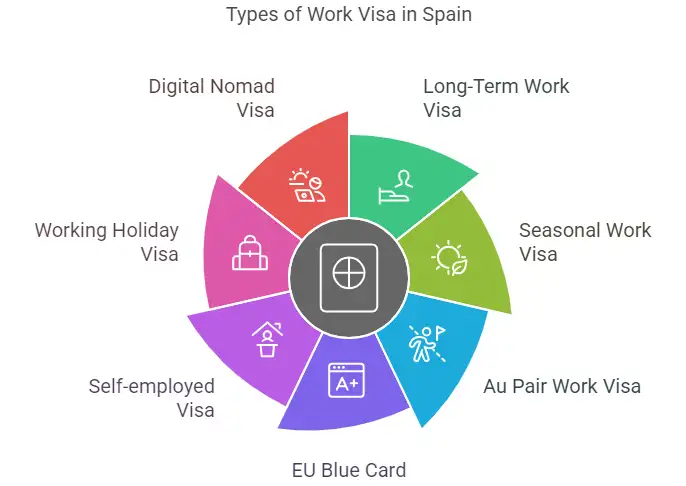
A Spain work visa is a long-stay visa that allows foreign nationals to enter Spain and legally work or start a business for a specific period. Spain offers eight distinct work visa types, including the EU Blue Card for highly skilled professionals, the Digital Nomad Visa for remote workers, and the Job Seeker Visa for those who want to arrive in Spain before securing employment.
Also read…
Spain sets up new Visa AMS for Schengen Visa
Types of Spain Work Visa
Spain offers different work visa options for foreign nationals, depending on the type of job and length of stay:
Long-term Spain work visa:
This is the most common work visa. It is issued to people who have a valid job offer from a Spanish employer. The visa is usually valid for 1 year and can be renewed.
Seasonal work visa:
This visa is for short-term jobs such as agriculture, tourism, or hospitality. It allows you to work in Spain for a few months under a temporary contract.
Spain Au Pair visa:
This visa is for young foreigners who stay with a Spanish family to help with childcare or household tasks. It is valid for 1 year and can usually be renewed once.
EU Blue Card:
Spain's EU Blue Card is for highly skilled professionals with higher education qualifications and a well-paid job offer from a Spanish employer. It allows you to live and work in Spain and move within the EU under certain conditions.
- Standard salary threshold: €39,269.92 per year gross (set by Orden PJC/44/2026, effective 30 January — this equals 1.4 times Spain's average gross salary per INE data). In Indian Rupees, this is approximately ₹36.2 lakh per year.
- Reduced threshold: €31,415.94 per year gross, available for applicants in shortage occupations or those who obtained their qualifying degree within the past 3 years.
- The EU Blue Card typically processes faster than standard long-term work visas, with an approximate processing time of 6 to 8 weeks once the employer authorisation is complete.
Spain self-employed visa:
This visa allows foreigners to work as freelancers or business owners in Spain. It can be renewed and may lead to long-term residence if all conditions are met.
Spain working holiday visa:
This visa allows young people (usually aged 18–30 years) to live and work in Spain for up to 1 year. It is available only to citizens of certain countries.
Spain Digital Nomad visa:
Spain's Digital Nomad Visa allows foreigners to live in Spain while working remotely for a company or clients based outside Spain. It is issued for 1 year and can be renewed. At least 80% of your income must come from non-Spanish sources.
Minimum income requirement (single applicant): €2,849 per month gross, which equals approximately €34,188 per year or approximately ₹31.4 lakh per year. This threshold is calculated as a multiple of Spain's national minimum wage and updates whenever the minimum wage changes.
| Applicant Type | Monthly Income Required | Approximate INR Equivalent |
|---|---|---|
| Single applicant | €2,849/month | Approximately ₹2.62 lakh/month |
| Applicant + 1 dependent | €3,765/month | Approximately ₹3.46 lakh/month |
| Applicant + 2 dependents | €4,070/month | Approximately ₹3.74 lakh/month |
| Applicant + 3 dependents | €4,375/month | Approximately ₹4.03 lakh/month |
Note: Qualifying Indian professionals may also be eligible for the Beckham Law 24% flat tax benefit — see the Beckham Law section below for full eligibility conditions.
Spain Job Seeker Visa (Visado de Búsqueda de Empleo):
Spain's Job Seeker Visa allows qualified professionals to stay in Spain for up to 12 months to search for employment without needing a prior job offer from a Spanish employer.
- Who can apply: Professionals with a recognised university degree or at least 5 years of relevant professional experience in their field.
- Key conditions: You cannot work during the job search period — the visa is strictly for searching. You must demonstrate sufficient financial resources, valid health insurance, clean criminal record, and proof of accommodation in Spain.
- After securing a job offer: You can convert the Job Seeker Visa to a Long-Term Work Visa or an EU Blue Card without needing to return to India, subject to meeting the relevant visa conditions at the time of conversion.
- Why this matters for Indian professionals: Indian IT, engineering, and healthcare professionals can physically attend interviews at Spanish companies, participate in tech events in Madrid, Barcelona, and Málaga, and build direct relationships with Spanish employers during the 12-month stay — something not possible on a standard tourist visa.
*Want to know about Spain Digital Nomad visa? Talk to Y-Axis for complete guidance.
Beckham Law — Spain's Special Tax Regime for Indian Professionals
The Beckham Law, formally known as the Special Tax Regime for Impatriates under Article 93 of Spain's Income Tax Act, offers qualifying workers a 24% flat tax on Spanish income up to €600,000 per year for a period of 6 years (the year of arrival plus 5 additional years). Income above €600,000 is taxed at 47%.
Who qualifies — all four conditions must be met simultaneously:
- You must be an employee of a non-Spanish company. Self-employed professionals and freelancers are generally excluded from this regime.
- You must not have been a Spanish tax resident in any of the previous 5 tax years before relocating to Spain.
- You must be relocating to Spain specifically for employment or professional reasons.
- You must submit Form 149 to Spain's Tax Authority (AEAT) within 6 months of arriving in Spain or registering with Spanish Social Security, whichever comes first.
Critical deadline warning: The 6-month Form 149 deadline is absolute and has no exceptions or extensions. Missing it means standard Spanish progressive income tax rates of 19% to 47% apply permanently for your entire stay in Spain, with no option to claim the benefit retroactively.
Tax saving example: At an annual salary of €70,000, the Beckham Law saves approximately €8,100 per year compared to the standard tax regime — approximately ₹7.5 lakh per year at current exchange rates.
Most In-Demand Jobs in Spain
Spain’s job market is growing due to strong economic performance, an ageing population, and skill shortages in key industries. Many companies are actively hiring foreign professionals, including Indians, to fill these gaps. Sectors like IT, healthcare, engineering, finance, construction, and hospitality have high demand. The table below shows some of the most in-demand jobs in Spain along with their average annual salaries:
| Occupations | Average Salaries per Year (€) |
|---|---|
| Software Developers & IT Engineers | €35,000 – €50,000 |
| AI / Machine Learning Engineers | €45,000 – €65,000 |
| Cybersecurity Specialists | €32,000 – €45,000 |
| Doctors & Medical Specialists | €45,000 – €72,000 |
| Nurses & Healthcare Workers | €24,000 – €35,000 |
| Civil & Mechanical Engineers | €30,000 – €55,000 |
| Renewable Energy Engineers | €35,000 – €55,000 |
| Data Analysts & Data Scientists | €35,000 – €52,000 |
| Finance & Banking Professionals | €30,000 – €50,000 |
| English Language Teachers | €18,000 – €28,000 |
| Hospitality & Tourism Managers | €22,000 – €35,000 |
| Construction Workers & Site Managers | €22,000 – €38,000 |
*Read more....
Average Salary Levels in Spain
Salaries in Spain depend on experience, job role, and location. Big cities like Madrid and Barcelona usually offer 15–25% higher salaries than smaller cities. High-paying sectors include IT, healthcare, finance, and engineering.
| Experience Level | Average Salary |
|---|---|
| Entry Level (0–3 years) | €18,000 – €26,000/year (₹17–24 LPA) |
| Mid Level (4–9 years) | €28,000 – €45,000/year (₹26–41 LPA) |
| Senior Level (10+ years) | €50,000 – €80,000+/year (₹46–74 LPA) |
Spain National Minimum Wage
Spain's national minimum wage (Salario Mínimo Interprofesional or SMI) is €1,221 per month gross, paid across 14 payments per year, giving a gross annual minimum of €17,094. In Indian Rupees, this is approximately ₹1.12 lakh per month or approximately ₹15.7 lakh per year.
Important note on Spanish payroll: Spain's 14-payment structure means employees receive two additional salary payments — typically in July and December — in addition to their 12 monthly salaries. When comparing Spain salary offers with Indian salary packages, always check whether the figure quoted is annual CTC across 12 or 14 payments.
Most skilled Indian professionals in IT, engineering, healthcare, and finance earn significantly above this baseline.
Top Companies in Spain Hiring Indian Professionals
| Company | Industry | Why It's Good for Indian Professionals |
|---|---|---|
| Banco Santander | Banking / Finance | Global bank with strong hiring and English-friendly teams |
| Inditex (Zara) | Retail / Fashion | Large global company with roles in logistics, tech, and business |
| Telefónica | Telecom / Technology | Major telecom company hiring in IT and data roles |
| Repsol | Energy / Renewables | Good for engineers and renewable energy professionals |
| SEAT / Volkswagen Spain | Automotive | Strong demand for engineers and developers |
| Amazon Spain | E-commerce / Tech | Offers visa sponsorship and global work culture |
| Accenture Spain | IT / Consulting | Hires for AI, cloud, and digital roles |
| IBM Spain | Technology / AI | Good for cloud and enterprise tech roles |
| Microsoft Spain | Software / Cloud | High demand for developers and engineers |
| Infosys / Wipro Spain | IT Services | Easy entry for Indian professionals |
| Deloitte / KPMG Spain | Consulting / Finance | Good for audit, finance, and consulting roles |
| Ferrovial / ACS Group | Construction | Large infrastructure firms hiring engineers |
Key Tips for Indian Professionals
- Use EURES (European job portal) to find jobs in shortage sectors with easier work permits.
- Apply for Spain's EU Blue Card if your gross annual salary meets or exceeds €39,269.92. A reduced threshold of €31,415.94 applies for shortage occupations or recent graduates. In Indian Rupees, the standard threshold is approximately ₹36.2 lakh per year.
- Check if companies offer visa sponsorship and English-friendly work culture.
- Focus on sectors like IT, engineering, healthcare, and renewable energy.
- Learn basic Spanish (A2–B1 level) to increase job opportunities and salary (up to 18% more).
- Use job portals like LinkedIn Spain, InfoJobs, and Tecnoempleo for job search.
Recent Spain Immigration Policy Updates
Three significant Spain immigration policy changes have taken effect recently. The EU Blue Card salary threshold was updated on 30 January per Orden PJC/44/2026. The Spain Digital Nomad Visa income threshold was updated on 26 February per Royal Decree 126/2026. Spain's national minimum wage took effect from 1 January per Royal Decree 126/2026. Always verify current thresholds with official sources before submitting your application, as these figures update periodically.
Job Market & Trends in Spain
- Growing Foreign Workforce: Spain has over 3.1 million foreign workers, making up around 14% of total jobs.
- High Demand for Skilled Workers: Over 30% of new jobs are expected to be filled by foreign workers.
- Key In-Demand Sectors: IT, healthcare, engineering, construction, manufacturing, hospitality, agriculture, and logistics.
- Visa Improvements: EU Blue Card rules updated and Job Seeker Visa extended to 12 months.
- Ageing Population: Low birth rates are increasing the need for foreign talent.
- Better Salaries: Many jobs offer 3–5 times higher salaries compared to India.
- EU Job Mobility: Working in Spain allows access to jobs across European Union countries.
- Long-Term Opportunities: PR available after 5 years and citizenship after 10 years.
*Read more.....
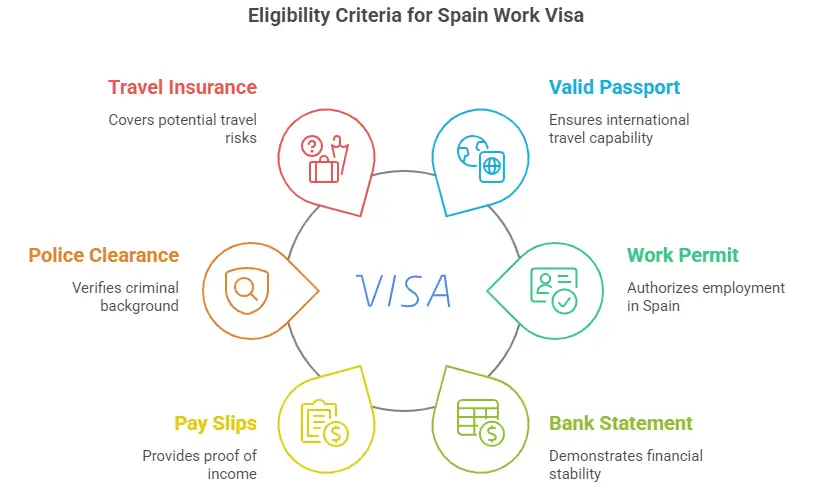
Eligibility for Spain Work visa
- Valid passport
- An approved work permit issued by Spanish authorities
- Proof of sufficient funds to support yourself in Spain
- Recent pay slips, if applicable, to show employment or income history
- Police Clearance Certificate
- Valid travel and health insurance covering your stay in Spain
- Must have a job offer from a Spanish company
- Provide a medical certificate
- Proof of accommodation
- Proof of professional qualification
*Also read…
Spain extends visa validity for UEFA
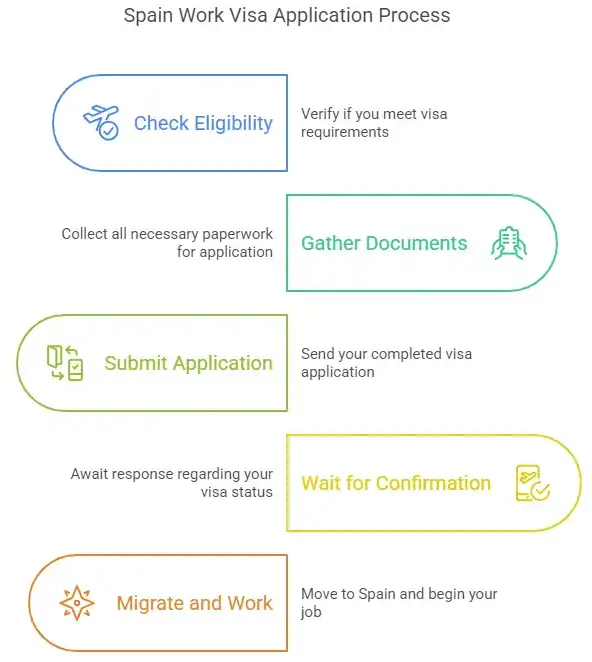
How to apply for a Spain work visa from India?
Step 1: Check if you meet the eligibility requirements for a Spain work visa.
Step 2: Secure a job offer from a Spanish employer and get a valid work contract.
Step 3: Gather all required documents, including your passport, work contract, and certificates.
Step 4: Book an appointment at the Spain visa application center or consulate in India.
Step 5: Submit your visa application and attend biometric verification, if required.
Step 6: Wait for the visa decision and track your application status.
Step 7: After approval, travel to Spain and start working legally.
Spain Work Visa fees for Indians
If you are planning to work in Spain, it is important to know the Spain work visa fees for Indians before applying. The visa fee depends on the type of work visa you choose, such as long-term employment, seasonal work, self-employment, or a working holiday visa. These fees are usually paid during the visa application process and may vary slightly based on the consulate or additional service charges. Below is the latest fee structure for different Spain work visa types for Indian citizens.
Here is the list of Spain work visa fees for Indians:
| Work Visa Type | Processing Fee (EUR) | Approximate INR Equivalent |
|---|---|---|
| Long-Term Spain Work Visa | € 154.20 | Approximately ₹14,187 |
| Spain Au Pair Visa | € 83 | Approximately ₹7,636 |
| Self-Employed Work Visa | € 100 | Approximately ₹9,200 |
| Seasonal Work Visa | €73–€550 | Approximately ₹6,716–₹50,600 |
| Spain Working Holiday Visa | €60–€100 | Approximately ₹5,520–₹9,200 |
| Spain Digital Nomad Visa | Verify current consulate fee before applying | — |
| Spain EU Blue Card | Verify current consulate fee before applying | — |
| Spain Job Seeker Visa | Verify current consulate fee before applying | — |
Note: INR equivalents approximate at ₹92 per Euro. Fees are paid at the Spanish Consulate or Visa Application Centre at the time of application and may vary slightly based on consulate location and additional service charges.
Spain Work Permit processing time
The processing time for a Spain work visa usually takes three months. Sometimes, processing a work visa in Spain might take only one month.
Here are the details of the processing time for a Spain work visa:
| Work Visa Type | Processing Time |
|---|---|
| Long-Term Spain Work Visa | 1–8 months |
| Spain Au Pair Visa | 2–4 weeks |
| Self-Employed Work Visa | 2–3 months |
| Seasonal Work Visa | ~1 month |
| Spain Working Holiday Visa | ~3 months |
Convert your Spain Work Visa to PR
Foreign professionals in Spain can apply for Permanent Residency (PR) after living and working in the country for a certain period. In most cases, you can apply for PR after 5 years of continuous legal residence in Spain. Spain does not use a point-based system like Japan. Instead, eligibility depends on how long you have lived in Spain legally, your employment status, and whether you have paid taxes and social security contributions regularly. After getting PR, you can live and work in Spain without restrictions. You can also apply for Spanish citizenship after 10 years, which gives you full rights and access to work across the European Union.
| Criteria | Details |
|---|---|
| Residency Requirement | Must live in Spain legally for 5 continuous years to apply for PR |
| Work & Contribution | Must have a valid job and regularly pay taxes and social security |
| PR Benefits | Freedom to live and work in Spain without visa restrictions |
| Citizenship Path | Eligible for Spanish citizenship after 10 years of legal residence |
| EU Mobility | Citizenship allows you to live and work across EU countries |
How can Y-Axis help you?
As the world’s No. 1 overseas immigration consultancy, Y-Axis has over 25 years of experience in providing unbiased and personalized services. Our experts offer complete support to make your Spain work visa process smooth and successful. Our services include:
- Y-Axis Resume Writing Services to create a strong, job-ready resume
- Expert guidance on Spain work visas
- Document checklist and application review to avoid errors and delays
- End-to-end visa application processing support
- Guidance on visa sponsorship jobs and employer connections
Y-Axis snapshot
1M
Successful applicants
1500+
Experienced counselors
25Y+
Expertise
50+
Offices
Don't know what to do?
Get free Counselling
Looking For Inspiration
Explore What Global Indians have to say about Y-axis

