
France Job Outlook
Down Arrow
Down Arrow
Down Arrow

I accept the Terms & Conditions

Don't know what to do
Don't know what to do ?

Get Free Counseling

France Job Market: Trends and Opportunities

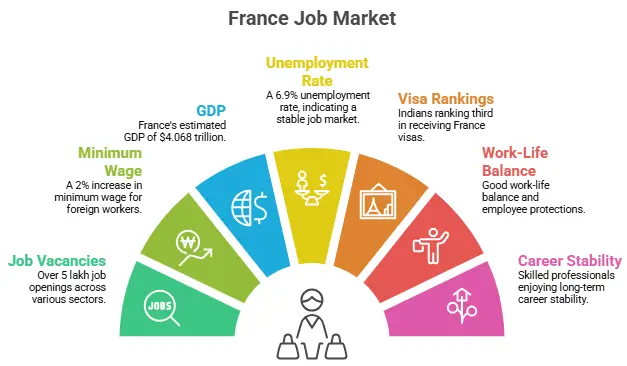
  • Over 5 lakh jobs vacancies in France
  • The minimum wage is increased by 2% for foreign workers
  • France’s GDP is estimated to be $4.068 trillion
  • France witnessed 6.9% unemployment rate
  • Indians ranked third in receiving the most number of France visas
  • France offers good work-life balance and employee protections
  • Skilled professionals have better long-term career stability in France

France has one of the largest economies in Europe and continues to invest in innovation, digital transformation, healthcare, and sustainable development. The country values work-life balance and provides employee protections, making it an attractive destination for international professionals.
Jobs for Indians in France

*Planning to migrate overseas?  Y-Axis will guide you in step by step process.

Job Outlook in France

The job outlook in France is positive and stable, supported by a strong economy and long-term government employment policies. France has a well-developed and diverse job market that offers opportunities across multiple industries. Skilled professionals who adapt to changing market needs and gain relevant experience can expect good career prospects over the next decade.

Top industries with high job demand include:

  • Information Technology and Technology Services
  • Healthcare and Nursing
  • Engineering and STEM fields
  • Tourism and Hospitality
  • Luxury Goods and Fashion
  • Education and Training
  • Management, Human Resources, and Administration
  • Marketing, Sales, and Finance

Understanding the job outlook for job seekers and employers

For Job Seekers

France offers good job opportunities for skilled professionals. The job market is stable and provides job security, fair salaries, and career growth. To succeed, job seekers should understand which skills are in demand and how government rules affect jobs. France is also known for a good work-life balance. Employees benefit from strong labour laws, safe working conditions, and social welfare support. Training and skill development programs help professionals grow their careers.

For Employers

Employers in France have access to a well-educated and skilled workforce. Workers are flexible, innovative, and committed to their jobs. This helps companies perform better and grow faster. The French government supports employers by investing in education and vocational training. This ensures that workers have the right skills to meet business needs. The job market in France benefits both job seekers and employers. There are many opportunities for growth, learning, and long-term success for both sides.

Job Trends in France This Year

Job trends in France depend on the economy, society, and government rules. France offers many job opportunities in growing industries. Sectors such as technology, engineering, healthcare, nursing, finance, education, marketing, sales, and human resources continue to offer good-paying jobs for skilled workers.

France supports a good work-life balance and allows flexible work options. This helps employees stay happy at work and remain with their employers for a long time. Strong labour laws and government support also provide a safe and stable work environment for both workers and companies.

Overall, France is a good choice for professionals looking for stable jobs, career growth, and a better quality of life.

Factors influencing job creation or reduction in France

Several factors affect job growth or job loss in France. The condition of the economy plays an important role, as companies hire more people when the economy is strong and reduce hiring when growth slows. Government rules and policies such as labour laws, taxes, and business regulations also influence job opportunities. Technology and automation are changing the job market by reducing some routine jobs while creating new roles in digital and technical fields. Global trade and international business affect the demand for workers, especially in the manufacturing and service sectors. Changes in the workforce, such as an ageing population and worker retirements, create new job openings. Tax policies and business costs also affect how companies decide to hire. Together, these factors shape job creation and job reduction in France.

*Read More.....

What are the benefits of Working in France?

In-Demand Jobs in France

France offers strong job opportunities across many industries. Skilled professionals are in high demand, especially in technical, healthcare, and business roles. Salaries in France vary based on experience, qualifications, and location, but many jobs offer competitive pay and long-term career growth. The table below shows some of the most in-demand jobs in France along with their average annual salaries.

Occupations Salary
Engineering € 55 160
IT and Software € 42 799
Marketing & Sales € 45 000
Human Resource Management € 65 000
Healthcare € 47 500
Teacher € 36 173
Accounting and Finance € 45 000
Hospitality € 35 900
Nursing € 71 000

 Read More..

Most In-Demand Jobs in France for the Next 10 Years

Most In-Demand Skills in France

Employers in France look for candidates who have both technical knowledge and soft skills. Along with job-specific skills, companies prefer professionals who can communicate well, adapt to change, work in teams, and manage their time effectively. These skills help employees perform better and support long-term career growth.

Job Sector Key Skills in Demand
Information Technology (IT) Digital literacy, technology skills, analytical skills, problem-solving, critical thinking
Engineering Problem-solving skills, analytical thinking, adaptability, teamwork, time management
Healthcare & Nursing Communication skills, teamwork, adaptability, customer service skills, time management
Finance & Accounting Analytical skills, critical thinking, attention to detail, communication skills
Business & Management Leadership and management skills, decision-making, communication, problem-solving
Marketing & Sales Communication skills, creativity and innovation, customer service skills, adaptability
Human Resources Communication skills, leadership skills, teamwork, problem-solving
Hospitality & Services Customer service skills, communication, teamwork, time management
Education & Training Communication skills, leadership, adaptability, critical thinking

Importance of Upskilling and Reskilling for Job Seekers in France

In France, job seekers need to focus on upskilling and reskilling to grow in their careers and stay competitive in the job market. Upskilling helps people learn new skills or improve the skills they already use in their current job or field. This allows professionals to perform better and move forward in their careers.

Reskilling is important for job seekers who want to change their job role or move into a new industry. It helps them learn skills that match current market needs and future job trends. By improving or changing their skills, job seekers can increase their chances of getting a job, earning better salaries, and finding long-term career opportunities.

Investing in skill development helps professionals stay relevant, adapt to changes in the job market, and build a stable and successful career in France.

Job Market for the Next 10 Years in France

Over the next decade, France is expected to see steady demand for skilled workers due to economic growth, digital expansion, and an ageing population.

  • France is projected to have around 700,000 to 800,000 job openings per year until 2035, mainly due to new job creation and workforce retirements.
  • Technology and digital roles such as software developers, data analysts, cybersecurity professionals, and AI specialists are expected to grow strongly.
  • Healthcare and nursing jobs will see long-term demand as France’s population continues to age.
  • Green energy and sustainability-related jobs will increase as France focuses on climate goals and renewable energy projects.
  • Business roles in management, HR, marketing, and finance will remain important as companies expand and modernize.

*Willing to Work in France? Y-Axis will guide you in all the steps.

Impact of Technology and Automation in France

Technology and automation are playing a major role in shaping the job market in France. Many industries are adopting new digital tools, machines, and automated systems to improve efficiency and productivity. As a result, the demand for skilled workers is growing across several sectors.

How Technology Is Changing the Job Market in France

Technological progress and automation are changing the way people work in France. Some routine tasks are now done by machines or software, while new roles are being created that require advanced skills. Jobs today focus more on problem-solving, technical knowledge, and creativity rather than repetitive manual work.

Automation is helping businesses grow faster and operate more efficiently. At the same time, it is creating new job opportunities in areas such as information technology, engineering, data analysis, artificial intelligence, robotics, and cybersecurity.

Growing Demand for Skilled Professionals in IT

Because of these changes, France has a strong need for qualified and skilled professionals, including foreign professionals. Many companies are looking for experts who can work with modern technologies and manage automated systems. This demand is especially high in sectors like IT, manufacturing, healthcare technology, and green energy.

Government Focus on Skills and Training

To support this shift, France is investing in:

  • STEM education
  • Vocational and technical training programs
  • Upskilling and reskilling initiatives for workers
  • Lifelong learning programs to help people stay job-ready

These efforts help professionals adapt to new technologies and stay competitive in the job market.

Remote Work and Flexible Jobs in France

Remote work and flexible job options are now common in France. Many companies allow employees to work from home or follow hybrid work models. This helps workers manage their time better and maintain a healthy work-life balance.

For employees, remote work reduces travel time, lowers stress, and offers more flexibility in daily schedules. For employers, it helps reduce office costs and allows them to hire talent from different regions and countries. Overall, remote work supports employee satisfaction and helps companies stay competitive, but it is now a standard practice and not limited to France alone.

Future Job Growth and Skill Development Plans in France

France has clear plans to support long-term job growth and strengthen its workforce. The government is actively working to attract skilled professionals, including foreign workers, to meet labour shortages in key sectors such as technology, healthcare, engineering, construction, and services.

France invests heavily in skill development, vocational training, and education programs to prepare workers for future jobs. These initiatives help people gain skills that match industry needs and support companies looking for qualified talent. The government also promotes innovation, digital growth, and green industries to create new job opportunities.

Currently, France has over 5 lakh job vacancies, and the number of openings is expected to grow in the coming years. Salaries are also projected to increase steadily, helping improve living standards. In addition, France continues to welcome international talent, with a large number of work and residence visas issued each year, including a significant share to Indian professionals.

How Government Policies Shape the Job Market in France?

Government policies play an important role in shaping the job market in France. Changes in labour laws, taxation, immigration rules, and investment policies directly affect hiring and job creation. By supporting businesses, encouraging innovation, and promoting employment-friendly regulations, France aims to create a stable and growing job market.

These policies help improve business confidence, attract investment, and create new jobs across sectors. They also support workers by offering job security, training opportunities, and social welfare benefits. Together, these efforts help France build a strong and future-ready workforce.

*Looking for jobs abroad? Talk to Y-Axis for expert guidance.

Challenges and Opportunities for Job Seekers in the France

Certain challenges are always faced by job seekers when it comes to finding employment. Below are some challenges that have been addressed and the tips and strategies for helping job seekers to navigate through the job market successfully:

Challenges faced by job seekers
  • Keeping up to date resumes
  • Being unclear and confused about application processes
  • No proper job information
  • Differences in skills
  • Language and cultural differences
  • Competitive job market
  • Limited opportunities
  • Feeling under confident
  • Networking difficulties
Tips and strategies for navigating the job market successfully
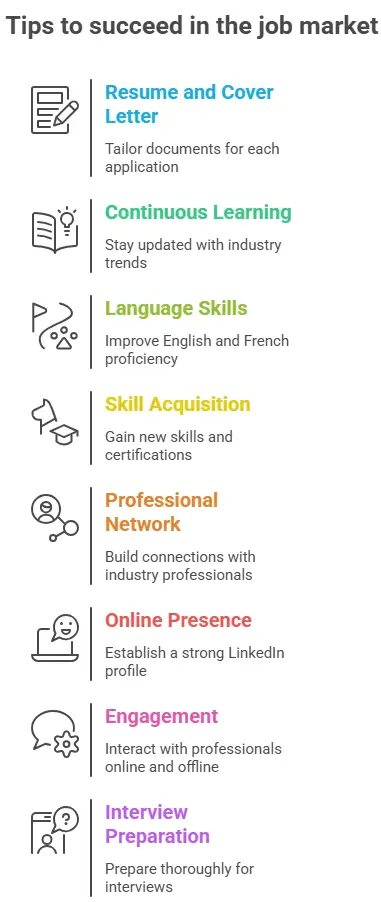
  • Create professional up to date resumes and cover letters for each application
  • Stay updated and invest in continuous learning
  • Improve your language skills, especially in English and French
  • Acquire new skills and certifications
  • Build a professional network
  • Create a strong online presence on LinkedIn and other related platforms
  • Engage with professionals through online platforms, and events
  • Be prepared for interviews

High demand jobs France

Summary of France Job Outlook

The job outlook in France presents a promising landscape filled with opportunities for job seekers across various industries. France is known for its resilience with a strong commitment to innovation and sustainability which drives economic landscape. Key sectors such as mentioned continue to thrive in the nation by offering abundant employment prospects for skilled professionals. Additionally, government support for businesses, investments in education and vocational training programs, and efforts to promote entrepreneurship foster an environment to job creation and economic growth. Job seekers in France can position themselves for success in a dynamic and evolving job market through continuous learning and willingness to adapt.

*Are you looking to seek employment in France and work overseas?  Get in touch with Y-Axis, the world’s no.1 work overseas consultant.

Sign up for a free expert consultation
Down Arrow
Down Arrow
Down Arrow

I accept the Terms & Conditions

Don't know what to do
Don't know what to do ?

Get Free Counseling

Looking for Inspiration

Explore what Global Indians have to say about Y-Axis in shaping their future

Frequently Asked Questions

What are the best job search websites for finding work in France?
plus

Here are some of the best job search websites for finding work in France:

  • France Travail: This is a national job service and an essential resource for job seekers across all sectors.
  • APEC (Association pour l'Emploi des Cadres) is a private French association that connects executives and companies for management positions.
  • Indeed, France is one of the best and most widely used job boards, providing job listings from various sources and sectors.
  • LinkedIn: A global professional networking platform with an active job search section in France, which helps to connect job seekers with companies.
  • Glassdoor provides job listings, company reviews, and salary information, making it a useful platform for job searches.
  • HelloWork is a good option for finding jobs and also for getting an idea of the company's work culture.
  • Jobtransport.com: This is a leading job site for the logistics sector in France.
Which industries are currently hiring the most in France?
plus

Many industries in France are currently hiring due to a lack of skilled workers and increasing market needs. Some of the sectors presently hiring the most in France are:

  • Retail and Sales: This is the sector with the highest number of vacancies in France.
  • Engineering and Construction: Fields like Construction, Aerospace, Automotive, and Metallurgy have strong job opportunities.
  • Healthcare and Personal Assistance: Due to increasing healthcare needs, there is a high need for caregivers, nurses, and support workers.
  • IT and Technology: The growing demand for digital transformation and cybersecurity has created numerous openings for IT engineers, data analysts, and cybersecurity specialists.
  • Manufacturing: Skilled trade workers are needed in engineering and other manufacturing roles.
  • Finance: Skilled professionals are needed to manage critical financial and administrative tasks.
What kinds of jobs are in demand in France right now?
plus

Here are the most in-demand jobs by sectors in France right now:

Industry / Sector

In-Demand Jobs / Roles

IT and Tech

Software Developers & Engineers, Data Analysts / Data Scientists, Cybersecurity Specialists, AI / Machine Learning roles, IT Project Managers.

Healthcare & Personal Assistance

Nurses, Caregivers / Support Workers, Physiotherapists, Allied Health Professionals, Hospital Logistics / Administrators.

Engineering

Civil Engineers, Electricians, Carpenters, Welders, Maintenance Technicians, Pipe Fitters.

Transport, Logistics & Supply Chain

Truck Drivers, Logistics Handlers, Warehouse & Last-Mile Delivery Personnel, Transport / Network Technicians.

Hospitality & Food Service

Cooks, Restaurant / Café Staff, Hotel Staff, Kitchen Assistants, Service Staff in Tourism & Hospitality.

Renewable Energy / Green / Environmental

Technicians in Renewable Energy; Energy Efficiency Specialists; Roles in Waste Management & Recycling; Power Station / Reactor Renovation.

Manufacturing & Industrial Maintenance

Machine Operators; Industrial Maintenance Technicians; Mechanical / Electrical Technicians; Equipment Installers / Fitters.

How easy is it for Indians to find jobs in the France job market?
plus

For Indians, finding jobs in France is possible, especially in high-demand sectors like IT, Engineering, healthcare, and logistics, having good chances for skilled professionals, especially under schemes like the France Talent Passport. Most public sector jobs are restricted to EU citizens, and some professions require additional certifications. Employers may face some challenges due to visa processes. Individuals with strong technical skills, relevant experience, and French proficiency have high chances of securing jobs in France's job market.

Are there companies in France that sponsor visas for foreign workers?
plus

Yes, France has several programs like the French Tech visa and talent passport, where companies can sponsor visas for foreign workers, mainly to attract skilled workers, researchers, and startup employees, particularly in sectors like tech, engineering, healthcare, finance, and energy, where there is huge demand for talent. Large companies like Airbus, L'Oréal, Danone, TotalEnergies, Orange, Schneider Electric, Société Générale, Thales, Carrefour, and Accor provide visa support. However, candidates must have strong qualifications, relevant experience, and sometimes French proficiency to qualify.

What are the requirements to work in France as an Indian citizen?
plus

To work in France as an Indian citizen, there are some requirements which are listed below:

  • You should have a job offer or employment contract from a French employer.
  • You must have a long-stay visa equivalent to a residence or relevant work permit.
  • A valid passport
  • A signed visa application form
  • Three recent passport photos
  • Documents of your educational degree and relevant work experience
  • Criminal clearance certificate
  • Proof of travel and health insurance
  • Proof of accommodation
What is the average salary for different jobs in France?
plus

Here is the breakdown of average salary for different jobs in France:

Role / Job

Average Annual Salary (Euros)

Data Analyst

€40,000–€55,000

Data Scientist / ML Engineer

€60,000–€90,000

Engineer roles

€30,000–€80,000

Legal / Lawyers

€60,000–€150,000

Healthcare Professionals (specialists)

€70,000–€200,000

Finance / Banking Roles

€50,000–€110,000

Entry-level / Junior roles (tech / IT / other)

€30,000–€45,000

What are the best cities in France to find a job?
plus

Here are some of the best cities in France to find a job and their advantages:

  • Paris has the highest number of opportunities in IT, Finance, consulting, fashion, and startups, with higher salaries.
  • Lyon is known for its pharmaceuticals, biotech, engineering, and IT industries, and is more affordable than Paris.
  • Toulouse is a hub for aerospace and aviation, providing Airbus and Engineering jobs.
  • Marseille has strong job opportunities in the logistics, trade, and tourism.
  • Lille provides jobs in the retail, manufacturing, and IT sectors
  • Bordeaux has more opportunities in wine, tourism, digital tech, and aeronautics
Where can I check current job openings in the France job market?
plus

To check for current job openings or to find jobs in France, you can explore online job boards and sites that provide job listings from various sources and sectors, such as:

  • France Travail
  • LinkedIn,
  • Indeed France
  • HelloWork
  • APEC
  • Cadremploi
  • Meteojob
  • Monster France
  • Jobteaser
  • Welcome to the Jungle
  • Company career pages
  • University career centers

Also, get help from recruitment agencies, which help candidates with temporary, permanent, and specialized roles. Some of these recruitment agencies are:

  • Adecco
  • Workforce
  • Hays
  • Michael Page Finance
  • Appel Medical
What are the most important skills needed to get a job in France?
plus

Here are the most important skills of each sector needed to get a job in France:

Sector

Key Skills

Technology & IT

Python, SQL, JavaScript, AWS, AI, Machine Learning, Cybersecurity

Healthcare & Nursing

Medical expertise, Patient care, Communication, Empathy, Teamwork

Engineering & Manufacturing

Technical proficiency, Problem-solving, Project management, Adaptability

Finance & Accounting

Financial analysis, Risk management, Regulatory knowledge, Communication

Sales & Marketing

Digital marketing, CRM tools, Negotiation, Customer relationship management

Education & Teaching

Pedagogical skills, Classroom management, Communication, Adaptability

Tourism & Hospitality

Multilingual communication, Customer service, Cultural awareness, Problem-solving

Retail & Distribution

Sales techniques, Inventory management, Customer service, Teamwork

Construction & Trades

Technical skills, Safety knowledge, Project coordination, Team collaboration

Do I need French language skills to work in France, or is English enough?
plus

French language skills are highly recommended for working in France, as most companies and workplaces use French as the primary language, especially outside multinational companies and tech startups. While English may be sufficient in certain international companies, startups, or IT and engineering roles where English is commonly used, having at least basic to intermediate French can improve your chances of securing a job, integrating into the workplace, and handling everyday tasks. For customer service, client-facing, healthcare, government, or public sector roles, proficiency in French is often mandatory.

What are the visa options for Indians who want to work in France?
plus

Several visa options are available for Indians depending on your job type, duration, and qualification. Some of these visa options are:

  • Short-stay work visa: This visa is for 90-day short-term employment. It requires a job offer and may not need a work permit.
  • Long-stay work visa: This visa is for long-term employment lasting more than 90 days. It requires a job offer and a work permit.
  • EU Blue Card: This is for highly skilled professionals with a job contract of at least one year.
  • Intra-Company Transfer Visa: Employees transferring to a French branch of their current company.
  • French Tech Visa: This visa is part of the "Passport Talent" scheme, which aims to attract international startups and entrepreneurs to France. It is valid for four years and can be renewed.
  • Seasonal Work Visa: This visa permits work for up to six months over 12 months for workers hired for agricultural or tourism-related roles
  • Temporary Work Visa: This visa is for fixed-term contract jobs and allows individuals to work in France for a limited period.
How can I get my Indian qualifications recognized in France?
plus

To get your Indian qualifications recognized in France, check if your degree falls under the mutual recognition agreement between India and France, which covers most Bachelor's, Master's, and PHD programs. You can get a Certificate of Comparability from ENIC-NARIC France to explain your Indian qualifications to French institutions. If you want to work in professions like law or medicine, you'll need approval from the respective French authority. Universities review foreign qualifications individually, and Campus France can guide you through the whole process for studies or jobs.

What is the work culture in France like for foreign professionals?
plus

The work culture in France is professional but balanced. Employees are expected to meet deadlines, attend meetings on time, and respect hierarchy. Vacation and personal time are respected, making work-life balance important. However, foreign professionals may find some difficulties adapting to the local work culture and need to learn French for better Communication with the locals. Teamwork is appreciated, and building good relationships with colleagues is encouraged.

What steps should Indians take to improve their chances of getting a job in France?
plus

Here are some tips and practical steps for Indians to improve their chances of getting a job in France:

  • Basic proficiency in French can significantly improve your job chances, particularly in public-facing or government-related roles, where multilingual skills are more in demand.
  • Focus on in-demand sectors like IT, Engineering, Healthcare, Finance, and aerospace, where skill shortages exist.
  • Use a concise, European-style CV highlighting relevant skills, certifications, and experience.
  • Use the right job portals like LinkedIn, France Travail, HelloWork and EnglishJobs.fr
  • Attend industry events, seminars, and webinars, and connect with professionals through LinkedIn to explore job opportunities.
  • Ensure your Indian degrees are recognized through ENIC-NARIC or the relevant authority.
  • Prepare for interviews with proper communication skills and technical skills.
  • Be patient and consistent, as the French job market can be competitive.
What sectors are expected to grow in the French job market in the coming years?
plus

France’s job market is expected to grow in several key sectors. Industries such as technology, healthcare, engineering, finance, and services will continue to create more jobs. This growth is driven by digital development, innovation, an ageing population, and increased demand for skilled professionals. These sectors offer good long-term career opportunities for both local and foreign workers.

How competitive is the job market in France for foreign professionals?
plus

The level of competition in France depends on the job role, industry, and location. Some sectors are more competitive, while others face skill shortages. Foreign professionals with relevant experience, strong qualifications, and in-demand skills have better chances of finding jobs. Knowledge of the French language and understanding local work culture can further improve job prospects.

Do employers in France prefer resumes in French or English?
plus

Most employers in France prefer resumes written in French, especially for local and customer-facing roles. However, English resumes are often accepted by international companies, multinational firms, and technical roles such as IT and engineering. Having a French version of your resume can improve your chances of getting selected.

Can international students stay and work in France after graduation?
plus

Yes, international students can stay in France after completing their studies to look for a job or start a career. France allows graduates to apply for a post-study stay permit, which lets them remain in the country while searching for employment or starting a business. Once a student finds a suitable job that meets salary and contract requirements, they can apply for a work residence permit. This policy helps international graduates gain work experience and build long-term careers in France, subject to current visa and immigration rules.

What qualifications are French employers looking for in candidates?
plus

French employers look for candidates who have relevant education, job-related skills, and practical work experience. Academic degrees and professional certifications are important, especially for technical and specialized roles. Employers also value good communication skills, the ability to work in a team, problem-solving skills, and technical knowledge. Having the right mix of education, skills, and experience improves job chances in France.